Showing posts with label Rickerby. Show all posts

Tuesday, August 9, 2011

Stock Agencies to Work With - Corbis - The Business of Photography by Brad Rickerby

Hailing a Cab, NYC
Corbis (www.corbisimages.com) is the second largest player in the stock photo marketplace. As noted in the last blog post, it has been reported that when combined, Corbis and Getty Images control upwards of 85% of stock photo sales. Every one else, goes industry wisdom, is just picking up the crumbs.

Corbis was founded by Bill Gates in 1989 and continues to be privately owned by him. Based in Seattle, Corbis markets a photographic library of around 10 million images.

Corbis Images markets both Royalty Free and Rights Managed stock photographs, illustrations and CD's. On the editorial side, they market documentary, fine art, archival, news, sports, entertainment and celebrity images. Corbis is know for handling many famous image collections, such as the Ansel Adams collections, and wide ranging vintage images. 

For quite some time, Corbis was not accepting new contributors. They now have a contributor application on their website (http://contributor.corbis.com/workwithus) so it seems that are taking new material.

Seattle Public Market Dusk
While I have worked with Getty, agefotostock and Alamy (the next two agencies I will be posting about) I have not worked with Corbis. As such I have no direct knowledge of their operations, company culture or of how they treat their image suppliers. I do know, however, that they have many, many excellent photographers who work with them and an excellent reputation for quality overall. 

I can only assume, given that excellent reputation, that Corbis is at least as difficult to get to work with as is Getty. You should, by all means, reach out to them. But you might want to have a back up plan as well.

As I mentioned previously, you may want to explore niche stock photo agencies too. These might just be a better fit for your images and quite a bit easier to get to work with than are Corbis or Getty. Just sayin ... 

I will get you information on niche agencies shortly.

Friday, August 5, 2011

Stock Agencies to Work With - Getty Images - The Business of Photography by Brad Rickerby

Let's face it, if you want to make money with stock photography, Getty Images (www.gettyimages.com) is the place to be. Getty is the number one stock agency in the world in both size and sales volume. When combined with Getty's closest competitor, Corbis (who is the topic of the next post) it has been reported that the two control upwards of 85% of the sales in the stock photography marketplace.

Enchantment
While Getty is THE place to be, it is exceptionally difficult to get Getty to represent your images. As such, I'm going to talk about Getty and three other agencies for your Rights Managed and Royalty Free images, Corbis, agefotostock and Alamy. Subsequently, I will post a blog on the microstock photo agencies that you can work with.

Getty Images is the bull in the stock photography market place china shop. They control the majority of licenses in the stock photography marketplace. Their power to make sales for you is enormous. To make the most money with your photos, they should all be placed with Getty.

This is particularly true of what is called the hero shot. You know the shot. You see it splashed across two pages of leading magazines. It is the photograph that tells the story in brilliant colors that just grab your eye and scream, "look at me". Getty loves the hero shot. The hero shot is what Getty sells best. Sure they also do the little inch square detail shot, but they love that image that tells it all. The hero shot has emotion and saturated colors and drama. It tells the story, conveys a mood and describes the human condition all in one dramatic moment, captured the instant it appears before immediately vanishing again.

The Runner
The hero shot is the one I always tried to capture. The images with this article are all hero shots created by me, that are in the Getty collection.

Every photograph represented by Getty is good, some are great. Getty licenses commercial stock images, editorial images, sports, celebrity and vintage photos too. They also have a video section and music tracks.

It would be great if you could get all of your images into the Getty collection. Sadly, this is not possible. Getty is extraordinarily selective about the photographers they will work with and the images they will represent. Further, Getty can be very difficult to work with.  A number of years ago, Getty CEO Jonathan Klein remarked that photographers were entirely replaceable. While this sentiment may be true, it is difficult to work with a company that has the attitude that you, as the supplier of its product, do not matter.

While Getty Images is the best bet for generating revenue, for these two reasons, you are going to have to spread your work around. Up next I talk about Corbis. You can be sure not to miss any of my posts by subscribing to my newsletter (above right).

Tuesday, August 2, 2011

The Royalty Free Stock Photography Model - The Business of Photography by Brad Rickerby

Joy at licensing at photo.
The Royalty Free (RF) stock photography license is much simpler than the Rights Managed license.  Under the Royalty Free model, when your image is licensed (as a reminder, we never, ever, sell our image, we just license the right to use them) the person who purchases the license can use that image anywhere they like, as often as they like, for as long as they like and in any quantity they like (just about).

In short, they can do virtually anything they want with your image, with just a couple of exceptions.

First, if the image is to be used on a product such as a t-shirt, coffee mug or something similar, they must purchase an "Extended License". The extended license is generally not much more expensive than the normal license.

Second, there are sometime, by some agents, a restriction on the maximum times a licensed image may be used. Different agents again set that upward limit at different numbers. istockphoto for example, allows for 499,999 impressions under a standard license and requires an extended license for higher numbers of impressions or for print runs of more than 500,000.

These limits are so high as to be of no concern to most of us. And again, if the buyer wants to use your image more than, in this case, 500,000 times, they can just pay a couple of dollars more.

One of my best selling microstock photos.
You would think that, given the virtually unfettered ability of the license purchaser to use your image, that a RF license would be more expensive than the previously discussed RM license. The exact opposite is, the case. RF licenses are, in theory, less expensive to purchase than are RM licenses. The cause of this pricing oddity has much to do with stock photo economics. (I will cover this topic more in another post).

The cost of an RF license can run from less than $1 USD to roughly $500 USD, depending on the image size licensed and the pricing model used by the agency. In my experience, RF licenses for more than $100 USD are extremely rare.

The lower price of the RF license would seem to make it a poorer revenue generator than its pricier cousin, the RM license. However, in theory, the lower your price point, the greater will be your sales volume. Increased sales should make up for the lower RF price point, at least against your average RM sale.

Another best selling microstock image.
There are two types of Royalty Free agencies. The first is the traditional stock agent who was forced to offer a RF license on some of its images in order to remain competitive. The second is the micro-stock agency. The microstock agency did great damage to the field of stock photography, but was inevitable given technology and the way images are used. And despite the fact that the microstock is evil, it may very well be the best way for you to make some of your money on some of your images.

I will talk about microstock pricing in my next blog post. Following that, I will discuss the actual agencies that exist for you to work with and then write about how to maximize your revenue by mixing your contributions to the various types of agencies.

And lastly, for the sake of transparency, the link to istockphoto above is an affiliate link that I will earn revenue from if you click through on it and then sign up with istockphoto. This all happens with no cost to you.

Thursday, July 28, 2011

The Rights Managed Stock Photography Model - The Business of Photography by Brad Rickerby

If you have just read my blog post on Stock Photography Then you are no doubt anxious to head off and look for a stock photo agent to market your images. I would urge you, however, to stick around and go over some of the options you will have in that search so that you can better maximize your revenue. A little more knowledge here is a lot more power.

It is important to know how a stock agency will license your image. Not as in how they will market or sell your image, but rather, as in what usage rights will be given and for what fee with each license model. There are basically two license models, Rights Managed (RM) and Royalty Free (RF). Today we are going to take on RM.

Please remember that when your stock photo agent makes a sale for you, they are not actually selling your image. What they are doing is licensing the use of your image. This is the way Bill Gates (of Microsoft) got rich. When you buy a Windows computer you are not actually buying the Windows software it comes with. Rather you are paying to use that software. Microsoft owns it, you pay to use it.

It is the same with your images. You retain ownership at all times (if someone wants to structure a deal with you where you give up ownership, walk away), and people pay you for the right to use the image. Which is great, because you can resell the same image over and over and over again.

The RM license model was the only license model available from the beginning of stock photography until just a few years ago.  The RM model manages the image on a license by license basis, so that in theory, you know exactly who has used the image and for what. The license for the image will specify the number of times it can be used (usually one), where it will be used, the size of use, the industry it will be used in (trucking, banking, entertainment, etc), the purpose of its use (whether editorial, advertising or something else) and a number of other particulars.

The fee for the license is based on these factors. Advertising use, for example, will fetch a higher fee than will editorial. All other things being equal, the larger in size or the greater the size of the print run, the higher the fee will be. And so on for many other factors.

Keeping track of who used each image and for what purpose is important for the user of the image. Careful tracking assures that there will be no conflicts in usage from one users to the next. Thus, an image can be used for advertising, say, a bank, with confidence that no other bank has used the same image.

RM licenses almost always used to have higher fees than RF licenses. These days, with special incentives to preferred clients, RM licenses may in fact have a lower fee than an RF license.

From the start of my career in stock photography until roughly 2002, my average RM license was about $1,000 USD with frequent spikes to $5,000 and $10,000. My highest license fee was $26,000. (Please keep in mind that this is the gross license fee and I split that fee with the stock agency.)

From 2002, RM license fees have steadily dropped.

In my next blog post I will cover RF licenses. You may wish to subscribe to my blog (the box on the upper right) to be sure not to miss that and other upcoming posts on the business of photography.

Sunday, July 24, 2011

What is Stock Photography - The Business of Photography by Brad Rickerby

Stock photography is a great way to make money by creating photographs.  If you are successful in stock photography you will be able to create wonderful images, travel to beautiful places and have the freedom to create your own schedule, working the hours you want to work.

The industry is extremely competitive now, much much more so than when I started back in the mid 1990's. There are many who will tell you that it is impossible to make a living through stock photo sales. To be sure, it will take drive and determination, but there are plenty of people who make very comfortable livings with their cameras in the field of stock photography.

So what is this great thing called stock photography? Very simply put, you create a beautiful, flawless image. That image gets put on file either in your own file or in the file of a stock photo agency. Buyers then come to either you or the stock photo agency looking for images that will meet their current project needs. When the image you created best meets the needs of a photo buyer, that photo buyer will license, for a fee, the use of that photograph. What could be simpler, right?

To the right are three images that I created while traveling to create images. The first is from Shanghai, China, the second, from Miami Beach, USA and the last from Beijing, China. Each of these images were put in the files of my stock agency, Getty Images, and later used by three different publishers.

Book publishers are not the only ones licensing images. Magazines use stock images all the time, as do web sites, corporations, ad agencies, newspaper, record labels and just about any one else who has a reason to use a photograph.  For example, the top image, taken on Nanjing Road in Shanghai China was also used by a retailer of Chinese language instruction programs. In fact, each of the images you see here has been licensed multiple times and I have been paid for each license.
It is the ability to have your images licensed and then re-licensed that makes stock photography so wonderful. While you sit at home with your family, images in your stock file from last week or from eight years ago can be being licensed for use over and over and over again.

In theory, so long as you continue to update your stock file, and with all other things being equal, your income will continue to grow. And keep in mind that updating your file is not work, it is fun. It is being creative and doing what you love.

Such a simplified explanation as this begs hundreds of other questions. Questions such as, Who are the different stock photo agencies, what makes them different from one another, how do I get to work with them and how much do they charge (and they all charge in one way or another)?

More, What is licensing, what types of licenses are sold, what type is best for me and the style of my work and how does the license type effect my income?

And still more, What type of image sells best, what makes a sellable stock photograph and what kinds of images are agencies more apt to accept? Along the same lines, What are the technical specifications of an acceptable photograph.

Also, How do you find models and photo locations? Do I need to use models? What is a model release?

These are all legitimate and important questions. And I can think of about a hundred more questions the answers to which, are vital to your success as a stock photographer.

I will be posting on these questions and many more. Indeed, I would love to post on your questions. Please feel free to ask questions either in the comments section or by emailing me.

You may also want to subscribe to my newsletter (where I will provide links to old posts in this series and titles of posts to come). Please use the box on the upper right of this page to subscribe.


My Mutant Honey and Her Mutant Flower - iPhone Photo

My Honey!
Photo by Brad Rickerby
Fine Art Prints Available

This is another in my series of iPhone photographs. For a change, I wish I had been using my professional camera. The moment was so great and the light, from the almost setting sun was so even and so soft, that I could easily see this picture being used under the concepts of green, home ownership or gardening. The picture has an edge, which is good sometimes. And the mode, my honey if you couldn't guess that, has the kind of every day attractive look that sells in stock photography.

The light has changed now. So maybe I will try to get her back out there tomorrow. This image is not usable for stock because it is just over 1 MB in size. No stock agency that I know of will use such a small image. We will see if tomorrow I can get all the visuals in this image to work together again.

Thursday, July 21, 2011

Fine Art Color Photograph by Brad Rickerby - iPhone Collection - Golden Retriever

Jake
The Old Golden Retriever
Photo by Brad Rickerby
Limited Edition Fine Art Prints Available

Another in the series of iPhone photographs, proving to me at least, that it is the photographer and not the camera that creates the image.

Poor old Jake was minding his own business when his nine week old Carin Terrior brother attacked, then attacked and attacked once more. It was relentless. When he finally found a touch of dappled sunshine with no puppy, I got this image where I think he looks both confused (why me?) and exhausted. Puzzled, that is the look in his eyes. This was taken with the instogram and one of the lovely filters provided the nice contrast.

Small size limited edition prints are available. Please contact me at brad@bradrickerby.com for details.


Thursday, July 14, 2011

Fine Art Color Cityscape Urban Photograph by Brad Rickerby - Bangkok

Motorcyclists - Bangkok, Thailand
Photo by Brad Rickerby
Limited Edition Fine Art Prints Available

This image deserves to be seen much, much larger. Alas, there is only a certain amount of space on this page. I choose this image to talk about next because we have, over the last several images, been on a discussion on what works best as a stock photo. This image has sold many times as a Rights Managed image through Getty, netting in the thousands of dollars. I guess that makes it a successful stock image, although it clearly violates one of the major principles of stock photography, simplicity. This image is not simple. It is complicated. In fact it is more like an abstract or Impressionist painting than it is a photograph. And that is why it works. The image gives you an impression of what a scene is like. It is as if you squinted your eyes to eliminate detail (which is, in fact, how many of the Impressionist painters painted).

What you are left with when you just have an impression of the scene is a photograph that delivers concepts, and that is key for stock photo sales. In the first place, when you combine this image with its location, Bangkok, Thailand you get a real story about that location. The picture tells you that Bangkok is exciting and fast-paced and dynamic. So the image works as a journalistic travel photo. Take away the location and you just have motorcycles speeding by. You have an illustration of the concepts of speed, motion, fast, an adrenaline rush and movement. All those concepts being illustrated leads to a lot of income.

To create an image like this you really have to look for backgrounds and imagine how they will look when you move the camera across them creating a blur. A single traffic light or a couple of street lights is not going to suffice to create this image. Look for lots and lots of lights (and, of course, a lot of traffic). In this case there were car headlights, neon signs, traffic signals, street lamps and a bridge with more lights on top. Having found the background, creating the image becomes a matter of just panning with the motorcycles so they are clear against the blurred background. Easy? Not at all. I spent all night creating this image. It takes a lot of repetition to get the pieces to all fall into place.

The image was created at f 4.0 at 4/10ths of a second. The ISO was 200 and the lens, a 70 mm.

Wednesday, July 13, 2011

Fine Art Color Photograph by Brad Rickerby - Jumping for Joy 2

Jumping for Joy 2
Photo by Brad Rickerby
Limited Edition Fine Art Prints Available

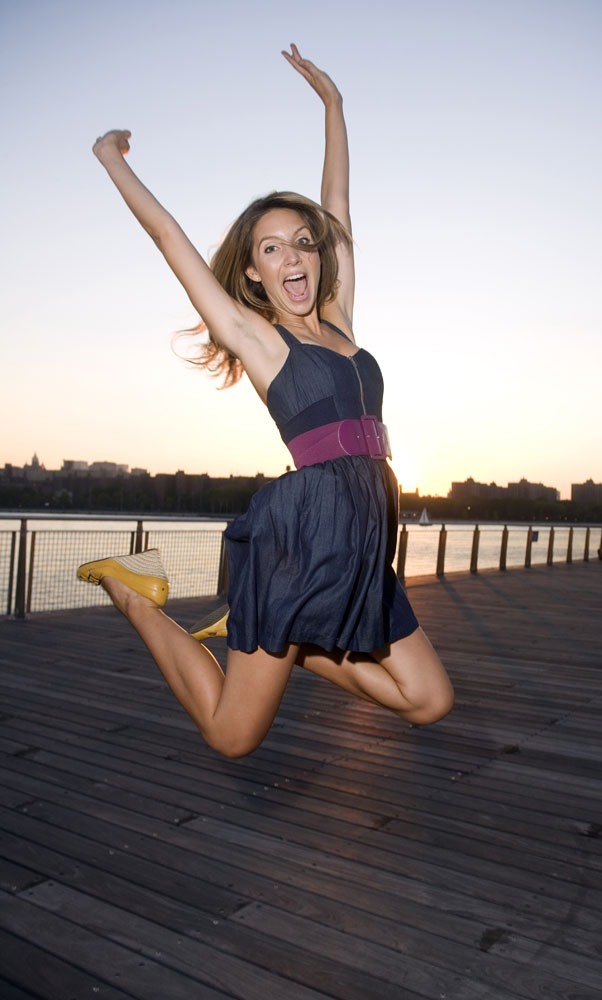
Another in my series of women jumping for joy. A great stock photograph needs to be simple and deliver many concepts. It also needs to feature attractive people, but no so attractive that they cannot be identified with. That last is important. No supermodels. And don't overdress (or undress) your models. Use clothing that would be worn by regular people. No huge diamonds. 

Along the same lines, while we are talking about dressing your models, logos of all varieties are huge no no's! Further, shooting outfits that are all black is discouraged. All black is harder to light properly and more difficult for the end user to reproduce correctly.

This image has been licensed any number of times because it follows these simple rules. It is conceptually diverse, representing the concepts of joy, victory, achievement and the like. Blaire is a cutie. Made up differently, she could be stunning, but with minimal make up, her hair down and an ordinary dress, she is easy to identify with. The dress is a good color and has no logos. 

This image was created digitally at an ISO of 250. It was shot at f 5.6 at 1/250th of a second with a 28 mm lens. A hand held flash using a wireless remote was used to balance against the back light.

You should not, if at all possible, use an on camera flash. Just moving the flash a very short distance off center creates a molding of your subject that gives it depth. On camera flashes will flatten your subject making them appear less attractive. A small investment in a wireless remote will pay itself back quickly in increased image sales.

Sunday, July 10, 2011

Fine Art Color Photograph by Brad Rickerby - Jumping for Joy 1

Meg - Jumping for Joy
Photo by Brad Rickerby
Limited Edition Fine Art Prints available


I did a whole series of people (mostly young women) jumping for joy. The image concept and execution are right out of the stock photographers handbook (or they would be, if there were such a book). The image is simple and consistently lit from front to back. The top leaves room for a masthead and both sides leave room for type. The image itself shows an emotion and represents a number of different concepts (joy, achievement, victory, success, youth, energy, craziness, etc.). That last point is crucial. It bears repeating. A good stock photo represents a number of different concepts. The photo will have many possible uses and will therefore sell much more than a single concept image.

This is a recent image and is digital. It was created with a zoom lens at 37 mm. The image was made at 3.2 at 1/320 of a second at an ISO of 800. I usually don't like to go that high on the ISO (recall that I shot Fuji Velvia 50 for decades) but the light was going so I had no choice. The higher ISO works here and if I were not so picky, would probably work in a variety of other situations.

Prints are available. For more information, please contact me at brad@bradrickerby.com.

If I wrote a book titled, "The Stock Photographers Handbook" would you buy it?

Thursday, July 7, 2011

Fine Art Color Abstract Photograph by Brad Rickerby - Hong Kong Harbor Abstract

Hong Kong Harbor Abstract
Photo By Brad Rickerby
Limited Editions Prints Available

This is one of the original images from my "City Lights" series, made on my second trip to Hong Kong. The image is on film, Fuji Velvia 50 (I loved that film).

You have to sit and watch the sun set over Hong Kong Harbor to understand just what a magical event that is. Capturing that magic on camera could be a life time project, there are so very many ways that it could be done. In this case a 200 mm lens was mounted with camera on a tripod. The film was set for a one stop push (to create a little grain and give me a tiny bit more latitude in the camera settings). This is about a ten second exposure with the lens set at f 2.8. During that ten second exposure I kicked the tripod, just a little bit, to give a blur to the overall image. Combine with the minimal grain effect from the film push, the image comes out more of a painting than a photographic likeness. This is exactly what I wanted.

I also waited for a boat to pass in front of me - in this case the Star Ferry leaving from Kowloon - to provide a light streak in the foreground.

I love the density of the modern buildings in the background, the overwhelming number of which have lit windows.

This image sold a lot back in the days when it was made. Buyers have become much more photorealistic these days and have moved away from this type of creativity. So sad!

For more information and to order prints, please contact me at brad@bradrickerby.com.

Tuesday, May 24, 2011

Fine Art Color Photograph by Brad Rickerby - My Dog Ginger

My Dog Ginger

Photo by Brad Rickerby

After two decades of carrying around 100 pounds of camera equipment, I am trying an experiment. I am now shooting with my iphone camera, proving to myself, once again, that it is not the fancy equipment that creates the photo, but rather the photographers eye.


You can see more of my iPhone photographic creations under the iPhone Photos tab on this bolg.

Saturday, May 21, 2011

Fine Art Color Portrait of a Couple Photograph by Brad Rickerby

Enchantment


Photo by Brad Rickerby
Limited Edition Prints Available


Enchantment, desire, fantasy, romance, love, lust, desire all of these emotional concept, and so many more apply to this photography. You know that the man is staring at this woman, that his gaze is fixed and while you can't determine what is going through his mind, you know that it involves her. What ever is emotion is, it is not indifference. But what about her. She is soft focused so that all we really know is that the figure is a woman. Does she share his intensity or is she indifferent. Will she jump wildly into his arms, to be consumed in his embrace, or will she shut him down with a shrug and a step away. By virtue of being defocused she brings mystery, a mystery that counters his emotion.

The image tells part of a story, and leaves us wanting more. As a device to deliver information that is a good photograph, but it is a better stock photograph because of the number of concepts it could be used to convey.

The image was created back in the old days of film on a Mamiya RG 67. The film is an Ecktachrome 100. The difficult part of creating this image was the placement of the two models. They had to be far enough apart so that his head would be sharp at f4, while she would be a blur that was identifiable as female. The strong backlight helped to blur her further.

Interested in a print? Contact me at brad@bradrickerby.com

Monday, May 9, 2011

Fine Art Color Cityscape Photograph by Brad Rickerby - Shanghai, China

Green Light
Shanghai China
Photo by Brad Rickerby

This little beauty was taken in Shanghai, China. I can tell you two important things about Shanghai right off the bat. 1) It is a long way from New York City (where I was based at the time I created this image), and 2) The people in Shanghai are utterly bemused at the site of a chubby caucasian guy, dripping camera equipment, with a tri-pod and 300 mm f2.8 lens taking a picture of a traffic light. Of all the places I have been, I appreciate the bemusement of the chinese people the most. I felt utterly safe there, more so than any where else. In fact, it has only been in the USA where I have been hassled by passers-by and the police and only in Los Angeles that I have been robbed, Given me China for safety any day.

This is a great picture for stock. First, it illustrates a concept very simply. Go, start, proceed and others such concepts are all shown by this image. Second, it is simple, yet colorful and has what we used to call in the old days, light box appeal. It jumps off the light box at you because of its color and saturation. A third beauty of this image is that it requires no model release and can't be identified with any specific location.

As I mentioned, this images was created with a 300 f2.8 lens mounted on a tri-pod. It has a narrow aperture to isolate the traffic light against a fuzzy bak ground. The image was created on film (Fuji Velvia 50). Finally, to get the slight blur effect, I kicked (very gently, I didn't want to be accused of tri-pod abuse) the leg of the tri-pod during the exposure. I took a number of these images, varying the kick intensity and duration, so I could be sure I got the effect I wanted (remember, it was in the days of film so I couldn't see the images until I had travelled more than 10,000 miles to the lab I trusted.

Please contact me at brad@bradrickerby.com for more info or prints.  Cheers.

Wednesday, April 27, 2011

Fine Art Color Cityscape Urban Photograph by Brad Rickerby - New York City

Taxi Cabs in Times Square NYC - Night

Night Cabs NYC
Photo by Brad Rickerby
Limited Edition Prints Available

This image was among my first in the City Light Series and was part of the original submission that got me a contract at Getty at a time when it was worth having a contract at Getty. I lived in New York City when this image was created and used to spend my nights, whenever I could, just wandering the streets looking for exceptional light with which to create an image. This image had great light so I had to work a bit to make the photo exceptional.

I found a place in Times Square where the traffic always stopped with three or four rows of cars so I could get some time to shot and also to have enough taxis to fill the frame (well yes, except for that tail light in the front middle that looks kinda like a Lincoln's to me, but don't tell anyone). It was great that the cab's did not line up straight. This gives a real feeling of dimensionality to the image. 

There are two ways to create this kind of image. The first is with a tripod and a long exposure. Just kick the tripod or jiggle the camera during mid exposure and you will get the shaken feel of this image.  I never much like carrying a tripod all over so I use the second method. Which is just to hand hold the camera and fire off several frames at once. When doing this I try to brace my body against a fence or parking meter or whatever support is available. I hold the camera in two hands, try to relax, take a deep breath and fire off 3 or 4 or 5 frames. It always seems that I am thinking about holding the camera on frames 1 and 5 and these are always unacceptably blurry. But the rest of the frames, where I'm not thinking so much, turn out to be very useable. 

This photo was created on film (Fuji, Velvia 50).  The exact setting were not recorded, but I know that the aperture was set at f2.8 and I'll bet that the shudder speed was in the area of 1 second. It was a 20 to 35 mm lens that I shook just a little bit at the end of the exposure.

Limited Edition prints are available. 
Please contact me at brad@bradrickerby.com

Thursday, April 21, 2011

Chris Hondros - Getty Photographer - RIP

I barely knew Chris Hondros. Back when I was a photojournalist we covered the same story a couple of times. But I don't think we ever actually met. Yet I feel saddened by his loss yesterday, at the end of a missile in Libya. Covering a war was always braver than I wanted to be. I have tremendous respect for those that do. Telling the story is vital. Chris knew that and was one of the best at doing that. It is fair to say that the world has suffered a great loss today. RIP Chris Hondros.


Wednesday, April 20, 2011

Fine Art Color Photograph by Brad Rickerby - Beautiful Woman

Kristen, Beautiful Woman

Kristen


Photo by Brad Rickerby
Limited Edition Prints Available

I don't do much studio work. I prefer to be outside, where I can try to create harmony from chaos - or something like that. I needed to get some studio shots for a project I was working on. I was in Los Angeles at the and put up an ad on Craigslist for models. I must have gotten about 100 replies. I ended up shooting Kristen and about a half dozen others.

I knew there was something special about Kristen when she walked in the door. She just oozed a depth of sensuality that I hadn't seen in any of the other models I had photographed. I knew I had to capture her sexy eyes staring directly into the camera, challenging any man who might look at the image to be worthy of her. I mussed her hair a little and asked her to part her lips, all in an attempt to bring out her raw sensuality. 

The lighting on this shot was very simple. I had a large soft box off to her right and let window light fill in the left side of her face. The window light was obviously no where near as bright as the soft box so left is darker than her right. If I were doing this over again I would have put a black board to her left so that very little light would be on her left. It would take some experimentation to create mystery without losing her beauty I think.

I have looked at this image hundreds of times. I remain captivated by her eyes. 


brad@bradrickerby.com


Monday, April 11, 2011

Fine Art Color Photograph by Brad Rickerby - Ghostly Runner

Ghostly Runner, Santa Monica, CA

Ghost Runner
Photo by Brad Rickerby
Limited Edition Prints Available

This was a stock shoot for Getty. Typical girl on the beach running at dusk. The concept was fitness, exercise, determination, drive etc. etc. etc. Just another in a long line of standard shoots with an expected outcome to fill the files of a stock agency that has thousands of other images just like it. Right?

Wrong! Not for me. To stand out, to make your product different and therefore more salable ay a premium price, you have to make your image unique. It has to jump off the light table (well, these days, the computer screen - I guess I go back a long way) and say to the buyer, "I am one of a kind. No other image that you can find will be like me".  I repeat this point often, because it is so basic to your survival as a photographer.

To differentiate my image on this day, I had the model, a women, keep running back and forth in front of me. Thirty feet one way, then turn around and go thirty feet back to where she started from. I had her jog rather than run. I knew if she ran fast, I would never get the image I wanted. I set the shutter speed at about a 30th of a second (at around f4) and shot away. In decades of looking at photographs I don't recall seeing many others like this one.

This is another image that has sold well through out the years.

Friday, April 8, 2011

Fine Art Color Photograph by Brad Rickerby - Piccadilly Line Photo

Piccadilly Line, Subway, London England

Piccadilly Line
Photo by Brad Rickerby
Limited Edition Prints Available

To be honest, it was pouring outside, really coming down, when I made this picture. You can see the rain on the windows of the subway car. So I escaped indoors, into the relative dryness of the London Underground where I made this great commercial/stock image. 

What in this image makes it good for commercial use? First, there is a large area at the bottom of the frame that can be used for text. That is really, really important. Advertisers want someplace to write about their message, so you have to leave them room somewhere. 

Second, the vast majority of the people's faces are blurred. They could be anybody, you maybe or your next door neighbor. (As an aside, back when this image was created the rules for model releases where less strict and this image got away for a long time being sold as commercial stock without a model release. That, of course, would never happen today). 

Third, it is a scene that most city dwellers and office workers can relate to. It can be placed in the business category and the business category sells best.

Finally, the blurs suggest action and direction and purpose. Those are there good concepts to have going for your image. Remember, stock photography revolves around the sales of concepts. The better your image illustrates a concept, the better it will sell.

 I created a picture that has sold well commercially and I managed to stay dry while doing so. What more could I ask for from a day of shooting!

Wednesday, April 6, 2011

Fine Art Color Abstract Photograph by Brad Rickerby - Models at Fashion Show

Abstract Photograph of Models on the Runway at a NYC Fashion Show.


Models on Runway


Photo by Brad Rickerby
Limited Edition Prints Available

When I worked for Reuters I covered the fashion shows in New York City every spring and fall. After several years of practice I came to know when I had the images I needed for my client. This show was of a lower level designer and I knew I had the shot early on. So I set myself the goal of creating something really creative and interesting and conceptual (and yes, salable as stock). I came up with several images that I really liked, including this one (and yes, it has sold very, very well over the years).

If you have ever watched a fashion show it seems all glamour and glitz. That is because the people bringing that image to you are not photographing themselves. To get the images that fashion magazines want, you have to be sitting directly at the end of the runway. That means that eight or ten photographers are going to get that image and all the rest have to settle for second best. The New York photo press photographers are quite a competitive bunch to begin with, but when you add in the photographers from England and France and Italy and Japan and ..... you get the idea, all competing for those few spots, what you get is chaos.

I enjoyed the competition because I figured out a way to get around it, a way to satisfy my client and to create a image that was unique from what everyone else was getting and to avoid the horror of being in the front row. I would find myself a spot in the back row, off center, where no one else really wanted to be and use my creativity to get really good and really different images. I needed large telephoto lens to create these images. This one was done with a 200 mm lens, but I would often use a 300 mm and on occasion go as high as a 600 mm. Then I would try to be a journalist and create an image that told a story about what the fashion show was rather than just what a dress looked like. Reuters was a news agency so this approach went over very well.

It is so important to keep in mind that you try to create something different than what every one else does. If it is for news or art or stock, when you create what every other photographer creates, your product is a commodity and can always be replaced by another photographer's image at a lower price. If you product is different buyers will have to come to you and pay what you are asking. I tend to go back to this point a great deal as it is fundamental to survival in photography.